

How Do You Incorporate Culture Into Daily Fashion?
Last Updated: November 7, 2026
Quick Summary
You incorporate culture into daily fashion by wearing pieces you already own, like a shell necklace or woven bag, with ordinary clothes such as jeans or a plain tee. Keep to one statement piece per outfit, know what it means, and buy from makers who credit the tradition.
- Pull out three items you already own and check if they work with jeans or a plain tee.
- Follow the rule of one statement piece per outfit so the cultural detail can breathe.
- Accessories like a woven tote or shell bracelet are the easiest entry point.
- Wear cultural clothing respectfully by knowing its meaning, sourcing it well, and caring for it.
- The more formal or unfamiliar the setting, the quieter the cultural detail should be.
Table of Contents
- Start With the Pieces You Already Own
- Cultural Fashion Examples You Can Wear Any Day
- How to Wear Cultural Clothing Respectfully
- Cultural Appreciation vs. Appropriation in Fashion
- Building Outfits for Different Settings
- Finding Your Fit When Your Heritage Is Mixed
- Shop New Arrivals That Celebrate Your Heritage
- Frequently Asked Questions
Start With the Pieces You Already Own
You already know how to incorporate culture into daily fashion. The proof is in your closet. Most people own at least one piece tied to their heritage: a shell necklace, a woven bag, a lavalava, a shirt with a pattern that reminds them of home. The trick is not buying more. It is wearing what you have with confidence.
Many shoppers freeze because they think cultural dress has to be saved for weddings and church. That thinking keeps beautiful pieces in a drawer for years.
So start simple. Pull out three items you already own and ask:
- Can I wear this with jeans or a plain tee?
- Is it comfortable enough for a full day?
- Does it feel like me, or like a costume?
If the answer is yes to the first two, you have your base. Layer a patterned wrap over leggings. Pair a carved pendant with a white button-down. Small moves like these turn heritage pieces into everyday wear.
Cultural Fashion Examples You Can Wear Any Day
Cultural fashion examples work best when one heritage piece leads and the rest of the outfit stays quiet. If you want to know where to buy lightweight island print shirts online, that guide covers it. A patterned wrap skirt with a plain white tee and sandals is a full outfit. So is a printed tote with jeans and a tank.
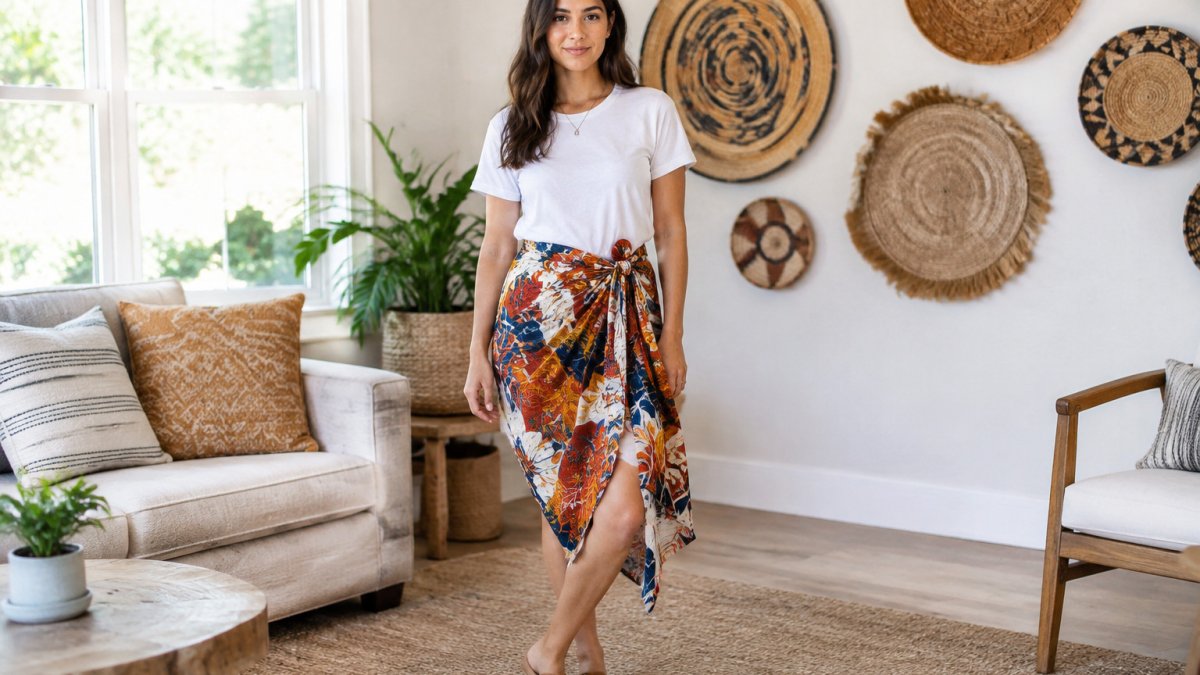
The rule we follow: one statement piece per outfit. Two loud pieces fight each other. One lets the cultural detail breathe.
Patterns, Prints, and Motifs
Traditional patterns carry meaning. Some mark family lines, some tell stories, some honor the sea or the land. A University of Arkansas study on culture and dress examined how college students work their culture into everyday wear, and the core idea holds at any age: what you wear signals who you are.
If you want to wear motifs daily, scale them down. A small print on a scarf or a border on a hem reads as personal style, not a statement.
Textiles, Jewelry, and Accessories
Accessories are the easiest entry point. They fit any body, any budget, and any dress code. A woven tote, a shell bracelet, or a carved pendant adds cultural texture without a full outfit change.
If you want pieces that add personality to an everyday look, our bags and accessories collection is built for exactly that.
Watch out: some "island-inspired" accessories copy a pattern without credit. Buy from makers who name the tradition behind the design.
How to Wear Cultural Clothing Respectfully
Wearing cultural clothing respectfully comes down to three habits: know what the piece means, buy from the community it comes from, and wear it with care. That is the whole framework.
Ask before you assume. If a garment has ceremonial meaning, it may not belong at the grocery store. Everyday pieces are usually fine. Sacred ones are not.
Then check the source. A maker who can tell you where a pattern comes from is a maker worth buying from.
Finally, treat the piece well. Clean it properly, store it flat, and repair it instead of tossing it. Respect shows in maintenance, not just in the purchase.
Cultural Appreciation vs. Appropriation in Fashion
The line between cultural appreciation vs. appropriation in fashion is credit and power. Appreciation honors a tradition and supports the people who carry it. Appropriation takes the look, skips the meaning, and profits from it.
Cambridge University Press research on cultural appropriation in global fashion describes how hard it is to legally protect cultural designs, which puts the choice in the buyer's hands.
A table helps, but it does not settle the hard cases. Use four questions as a decision framework before you wear or buy a piece.
1. What does the item mean? Some patterns mark family lines, some tell stories, some honor the sea or the land, and some are ceremonial. Everyday pieces are usually fine to wear; sacred ones usually are not. If you cannot explain what the piece means, you are not ready to wear it in public.
2. Who made it, and who benefits? A named maker or community that profits from the sale is a different transaction from a mass retailer selling an unnamed "tribal" print. Ask where the pattern comes from and who gets paid.
3. Is permission part of the tradition? Some garments are meant to be given, earned, or worn only by certain people. When permission is part of the custom, wearing the piece without it is the problem, not the style.
4. How will you wear it? Everyday wear with care is different from a one-time costume. If a piece is worn once for a theme party and never again, it was a costume.
Here is how the signals line up:
| Signal | Appreciation | Appropriation |
|---|---|---|
| Source | Named maker or community | Unnamed "tribal" or "ethnic" label |
| Money | Pays artisans fairly | Goes to a mass retailer |
| Meaning | Explained and respected | Stripped or ignored |
| Permission | Followed where the tradition requires it | Skipped |
| Use | Everyday, with care | Costume or trend |
That last row matters most. If a piece is worn once for a theme party and never again, it was a costume.
Wondering why respectful pieces cost more? Our article on why artisan-made clothing costs more than fast fashion breaks down the real numbers.
Building Outfits for Different Settings
One outfit does not fit every setting. The practical move is to build a small rotation where the cultural piece stays constant and everything around it changes. Below are complete looks for four settings, each built from pieces most people already own plus one heritage item.
Work. Lead with a quiet detail and keep the silhouette conventional. A small carved pendant on a fine chain over a white button-down, dark trousers, and loafers reads as personal style in most offices. A patterned scarf tied at the neck or worn as a headband works the same way. If your workplace is conservative, keep the cultural element to one item and let the rest of the outfit stay neutral. A patterned blazer is a bigger swing; save it for workplaces where people already dress expressively.
School or campus. This is where you can be louder. A printed tee with jeans and sneakers is a full outfit, and a wrap skirt over leggings with a plain long-sleeve tee works in cooler months. A woven tote carries books and adds texture at the same time. The trade-off is durability: delicate textiles and heavy backpacks do not mix, so keep the fragile pieces for weekends.
Casual weekends and errands. One statement piece does the work. A patterned wrap skirt with a plain white tee and sandals, a printed tote with jeans and a tank, or a shell bracelet with a denim jacket and chinos. This is the setting where a cultural piece becomes normal, because it is worn next to ordinary clothes rather than treated as an event.
Formal events and family gatherings. Go fuller. Layered textiles, a patterned dress or lavalava, and jewelry that matches the occasion. The rule flips here: the more formal the room, the more the cultural piece can lead, because formal dress codes already expect a deliberate outfit. Just confirm the dress code first, since a ceremonial garment may be wrong for a black-tie wedding even when it is beautiful.
A simple pattern ties the rotation together. The more formal or unfamiliar the setting, the quieter the cultural detail; the more casual and familiar the setting, the more the piece can lead. Build the rotation one setting at a time, and wear each look somewhere ordinary before you wear it somewhere important.
Watch out: a piece that works at a family gathering can read as a costume at a workplace event, so test each look in a low-stakes setting first.
Finding Your Fit When Your Heritage Is Mixed
Mixed heritage is not a problem to solve. It is a wardrobe with more than one language, and you get to choose the accent each day.
If you feel unsure about claiming a piece, start with the side you know best. Add one element at a time. Nobody is grading you.
For families blending traditions, our guide on choosing Polynesian clothing for mixed heritage families goes deeper on this.
Shop New Arrivals That Celebrate Your Heritage
Heritage dressing works best when it starts small and grows. Pick one piece, wear it weekly, and let it become normal. That is how culture moves from the closet shelf into real life.
Our island-inspired styles suit this kind of everyday wear. The Island Holiday Collection has gifts and keepsakes rooted in Polynesian traditions, including the Tongan Christmas Tote Bag at $25.99 and the Samoan Christmas Floral Tote Bag at $21.99. For little ones, the Tongan Toddler Sweatshirt at $29.99 brings island pride to any family gathering.
Start with one piece this week. Wear it somewhere ordinary. Get started with Wake Up and Live and make your heritage part of your daily wardrobe.
Building a wardrobe that reflects who you are takes small, steady steps. We curate feel-good fashion for women, men, and children, with island-inspired styles and everyday pieces that help you slow down and live with intention. Explore our new arrivals and find the piece that feels like you.
Frequently Asked Questions
How can I incorporate my heritage into everyday outfits?
Start small and build from what you already wear. Swap a plain tote for one with a cultural motif, add a woven bracelet to your daily watch stack, or layer a patterned scarf over a neutral outfit. Choose one or two meaningful pieces per look rather than building the whole outfit around heritage items. This keeps your daily fashion practical while letting cultural details show up consistently.
What is the difference between cultural appreciation and appropriation in fashion?
Appreciation involves learning about a culture, crediting its source, and buying from makers within that community. Appropriation takes a sacred or significant symbol, strips its meaning, and sells it without context or benefit to the originating culture. Ask three questions before buying: Do I understand what this symbol means? Does the maker come from this culture? Would someone from that community recognize this as respectful? If any answer is no, pause.
How can accessories add cultural influence to an outfit?
Accessories are the lowest-risk entry point. A carved pendant, a woven bag, or a patterned scarf adds cultural context to jeans and a tee without overwhelming the look. They also let you test how a piece feels before investing in larger garments. Choose one accessory as the focal point and keep everything else neutral so the cultural detail reads as intentional.
What are some examples of cultural fashion I can wear to work?
Look for pieces that blend cultural detail with office-appropriate structure: a blouse with subtle embroidery at the collar, a tailored jacket in a traditional weave, or a tote with a cultural print used as your daily bag. Keep the silhouette modern and let the cultural element sit in the fabric, trim, or accessory. This reads as personal style rather than costume.
