

Where to Buy Lightweight Island Print Shirts Online in 2026
Table of Contents
- Where to Buy Lightweight Island Print Shirts Online: What to Check First
- Lightweight Hawaiian Shirts vs. Island Print Shirts: Know the Difference
- Fabric Weight and Breathability: The Hot-Weather Comfort Test
- How to Choose a Shirt Size Online Without Getting Burned
- Print Quality, Colorfastness, and Garment Durability
- Read the Online Clothing Return Policy Before You Click Buy
- Shipping, Delivery Timelines, and Inventory Checks
- Conclusion
- Frequently Asked Questions
Last Updated: October 21, 2026
Where to Buy Lightweight Island Print Shirts Online: What to Check First
Buying island print shirts online comes down to five checks: fabric weight, size chart accuracy, print method, return window, and live inventory.
The market is real and growing. Mordor Intelligence's custom T-shirt printing market analysis estimates the custom printing segment at $7.63 billion in 2026, climbing at an 11.56% annual rate through 2031.
Here is what separates a shirt you will wear all summer from one that hangs in the closet.
Lightweight Hawaiian Shirts vs. Island Print Shirts: Know the Difference
Lightweight Hawaiian shirts are a specific garment: short-sleeve, camp collar, usually rayon or cotton, with a documented print tradition. Island print shirts are the broader category, covering tropical prints on tees, button-downs, dresses, and unisex cuts.
The distinction matters when you shop. A Hawaiian shirt listing tells you the collar style and drape. An island print listing might be a boxy tee with a palm print.
- Hawaiian cut: camp collar, straight hem, relaxed through the body
- Island print tee: standard crew neck, closer fit, cheaper to produce
- Unisex island shirt: sized for a broader range, check the chest measurement
If you want the traditional look, search for "Hawaiian shirt" specifically. If you want everyday casual wear with tropical leaves or a floral pattern, the wider island print category gives you more options.
Fabric Weight and Breathability: The Hot-Weather Comfort Test
Fabric weight decides whether a shirt breathes, but "lightweight" on a product page is a marketing word, not a measurement. The job is to translate fiber, weave, and GSM into a prediction about how the shirt will feel at 90°F with humidity.
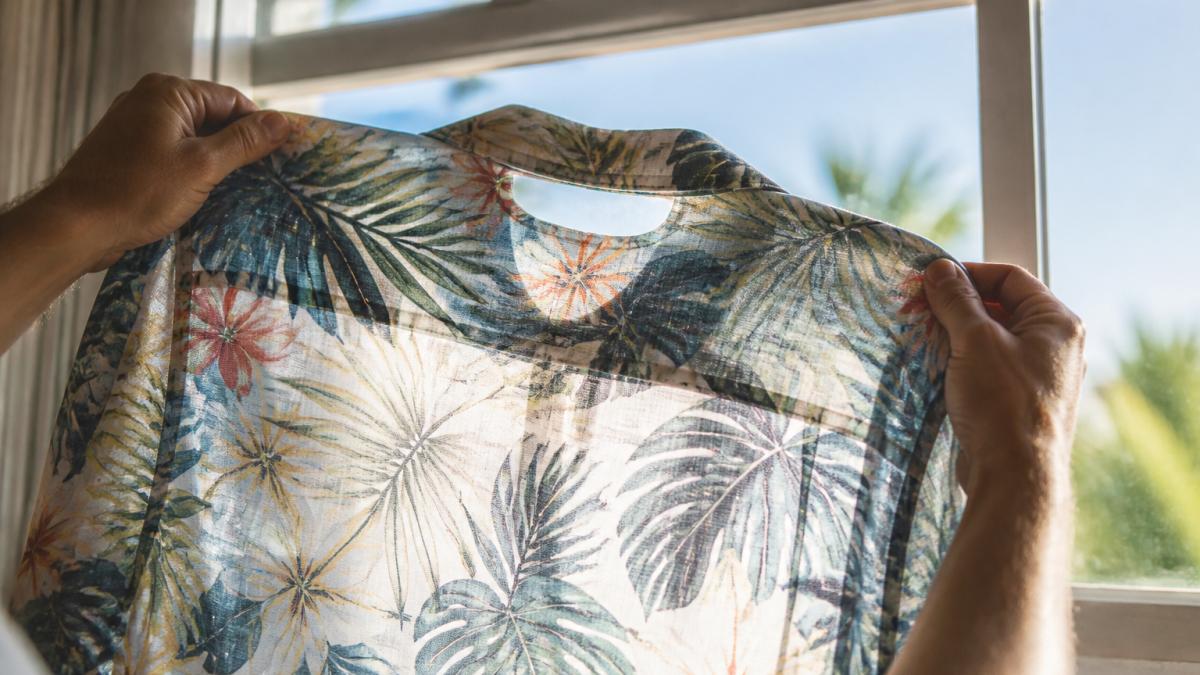
What the numbers actually mean
GSM (grams per square meter) is the single most useful spec a seller can give you. As a working scale for warm-weather shirting:
- Under 100 GSM: voile, lawn, and very fine cotton. Extremely airy, often semi-sheer, wrinkles if you look at it wrong.
- 100-120 GSM: the sweet spot for hot-weather button-downs. Light enough to breathe, opaque enough to wear to dinner.
- 120-150 GSM: standard shirting weight. Fine in dry heat, sticky in humidity.
If a listing gives no GSM, ask. A real apparel seller can answer in one message; a dropshipper usually cannot.
Fiber-by-fiber: how each one behaves in heat
- Rayon (viscose): the classic Hawaiian shirt fiber. Drapes beautifully, feels cool to the touch, breathes well at 100-120 GSM. Downsides: wrinkles easily, can shrink, and weakens when wet, so it needs a gentle cold wash.
- Cotton voile and lawn: plain-weave cotton at 80-110 GSM. Very breathable, holds print detail crisply, and gets softer with washing. Can be semi-sheer in light colors.
- Linen and linen-cotton blends: the most breathable option in humid heat because the fiber wicks and dries fast. Wrinkles are part of the look. Blends with cotton reduce the crumple.
Weave and construction matter as much as fiber
A plain weave (over-one, under-one) lets air pass; a tight twill or densely printed panel does not. Two more construction cues:
- A camp collar and straight hem allow more airflow at the neck and waist than a buttoned collar and tucked hem.
- Side vents or a boxy cut move air through the body instead of trapping it.
- A print applied as a thick plastisol layer can seal the weave and kill breathability even on a light fabric. Ask whether the print sits in the fabric (dye or DTG) or on top of it (heavy screen ink).
The product-page test
Run this before you buy:
- Find the fiber name. "Poly blend" with no percentages is a red flag.
- Find the GSM or ask for it. Under 120 is genuinely light.
- Check the weave. Plain weave and voile breathe; twill does not.
- Read reviews for "stiff," "hot," or "see-through." Multiple mentions are a pattern, not an outlier.
- Ask about colorfastness. Light dyes on thin fabric can bleed in the first wash.
A common mistake is buying on print alone. A beautiful blue leaves pattern on heavy polyester is still a hot shirt. Fabric first, print second.
How to Choose a Shirt Size Online Without Getting Burned
Sizing is the number one reason online clothing orders get returned. The fix: ignore the letter size and match your body measurements to the seller's flat garment measurements. Measure a shirt you own that fits well, lay it flat, and measure armpit to armpit, then shoulder seam to hem.
| Measurement | Where to Measure | Why It Matters |
|---|---|---|
| Chest (flat) | Armpit to armpit, doubled | Predicts tightness across the body |
| Body length | Shoulder seam to hem | Tells you if it tucks or hangs |
| Sleeve length | Shoulder seam to cuff | Matters for short sleeve fit |
| Shoulder width | Seam to seam across the back | Explains drape and armhole comfort |
If a listing has no size chart, that is your answer. Move on. A seller who cannot publish measurements cannot support a return either.
Do not trust "true to size" claims without a chart. Sizing varies wildly between manufacturers, and a shirt labeled Large can run two inches narrower than the same size elsewhere. Skipping this check is how buyers end up with a shirt that fits nothing like the photo.
Print Quality, Colorfastness, and Garment Durability
Print quality separates a shirt that survives fifty washes from one that fades by August. Three production methods dominate:
Screen printing lays down thick, opaque ink. It holds color well on cotton but can crack if the ink is cheap. Direct-to-garment (DTG) printing handles detailed tropical patterns and photographic designs, though vibrancy fades faster on dark fabric. Embroidery is durable and textured, best for logos and small motifs, not full prints.
What most guides miss is the wash test. Ask the seller, or check reviews, for how the print holds after cold washing and air drying. Heat is the enemy: hot water and a hot dryer break down both dye and elastic fibers.
Look for these signals of a durable garment:
- Reinforced side seams and a clean hem
- Print that sits in the fabric, not thickly on top of it
- Care instructions that name a cold wash
Read the Online Clothing Return Policy Before You Click Buy
An online clothing return policy governs whether you can send a shirt back, who pays shipping, and how long you have. Read it before checkout, not after the shirt arrives wrong.
- Return window: commonly 14 to 30 days from delivery
- Condition rules: unworn, tags attached, original packaging
- Who pays return shipping: often the buyer unless the item was defective
Personalized shirt orders deserve special attention. Custom designs, including embroidered names and event T-shirts, are frequently non-returnable because the seller cannot resell them. That is fair, but confirm sizing before ordering a custom piece.
Shipping, Delivery Timelines, and Inventory Checks
Shipping speed and stock status are what buyers ask about most, and what sellers obscure most often. A shirt listed as "in stock" can still ship three weeks late if the seller dropships from overseas. Separate the order into its real stages and put a number on each before you pay.
The four clocks in every online apparel order
Every order runs on four separate timelines that sellers often blur into one vague "ships in 3-5 days." Pull them apart:
- Handling time: how long the seller takes to pick, pack, and hand off. Two business days is reasonable for in-stock apparel; five to ten days usually means the item is made to order or sourced on demand.
- Transit time: carrier time in the network. Domestic ground is typically 3-7 business days; expedited is 1-3. International can run 2-6 weeks and is the biggest source of "where is my order" complaints.
- Customization time: embroidery, screen printing, or personalized names legitimately add one to three weeks. This is production, not shipping, and should be quoted separately.
What shipping should cost
For domestic apparel orders, common patterns are:
- Free standard shipping above a threshold (often around $50-$75), with paid expedited upgrades.
- Flat-rate standard shipping in the $5-$10 range for orders under the threshold.
- Carrier-calculated rates that vary by zone and weight.
If a seller charges premium shipping but quotes a long handling time, the two numbers contradict each other. Ask which one is real.
Inventory signals that separate real stock from dropship listings
- Size-level stock display. A real inventory system shows which sizes are sold out. A page where every size is "available" is often a catalog feed, not a warehouse.
- Restock dates. Sellers with real stock can give a date. "Coming soon" with no date is a placeholder.
- Tracking included? A seller that cannot provide tracking cannot tell you where your order is. Tracking should be automatic, not a favor you request.
A simple pre-purchase script
Message the seller with three questions before checkout:
- "Is this size in stock now, and what is the handling time before it ships?"
- "Will I get a tracking number, and which carrier do you use?"
- "What is the return window and who pays return shipping?"
A responsive seller answers within a business day with specifics. A seller who dodges the question, or answers only with marketing language, is telling you something. That one message is the cheapest insurance available.
Do not confuse a fast website with fast fulfillment. A polished product page and a two-day checkout flow say nothing about whether the shirt is in a warehouse or on a slow boat. The handling time and the return address are the two facts that reveal the difference.
Conclusion
The difference between a shirt you love and one you regret comes down to five minutes of checking: fabric weight, a real size chart, print method, return terms, and a confirmed ship date. Tropical leaves and a beautiful floral pattern are worth nothing if the shirt is stiff, mis-sized, or stuck in a warehouse.
Our island-inspired styles for women, men, and children are built for everyday wear, with a curated collection of feel-good fashion and unique gifts designed around intentional living. Browse our new arrivals, check the size chart on each listing, and message us with any fit question before you order.
Frequently Asked Questions
Where can I buy lightweight island print shirts online?
Look for online shops that publish fabric weight, show real product photos on models, and state a clear return window. Island print shirts are sold by specialty island-inspired brands, print-on-demand marketplaces, and general apparel retailers. Start with shops that list the material (cotton, rayon, or a blend) and the fabric weight in ounces per square yard, then confirm shipping and returns before ordering. Wake Up and Live carries island-inspired styles for the whole family, and you can browse the current selection on its site.
What should I look for in a lightweight island print shirt?
Check four things: fabric weight (lighter fabrics under about 4.5 oz per square yard breathe better in heat), print method (screen printing and dye sublimation hold color differently), sizing chart (measure a shirt you already own and compare), and return policy. Also read the care label, since lightweight tropical prints often need cold washing and line drying to keep colors from fading. A shop that shows these details up front is usually a safer buy than one that hides them.
How can I check an online shirt's fit before ordering?
Measure a shirt you already own that fits well: lay it flat and measure the chest from armpit to armpit, the body length from the collar seam to the hem, and the sleeve length. Compare those numbers to the shop's size chart rather than trusting the label size, because a medium from one brand can match a large from another. If the chart only lists body measurements, email the shop for garment measurements before you buy.
What should I check in an online clothing return policy before buying?
Confirm the return window (30 days is common, but some shops allow less), whether returns are free or you pay shipping, whether the item must be unworn with tags attached, and whether sale items are final sale. Also note whether the shop offers exchanges for a different size, since that matters more with apparel than a refund. Save the policy page or a screenshot when you order so you have the terms on hand if something goes wrong.