

How to Choose Polynesian Clothing for Mixed Heritage Families
Quick Summary
Polynesian clothing for a mixed heritage family works best when each piece suits the person wearing it and the occasion. Choose designs that name their specific culture and island, and check that the maker can explain where the motifs come from.
- Ask which specific culture and island a design is drawn from before buying.
- Mixing motifs from several Polynesian cultures into one print can strip each one of its meaning.
- Sacred or family-specific motifs should come with a clear explanation of how permission was obtained.
- Build a rotation of everyday, portrait-and-event, and ceremonial pieces rather than one bold outfit.
- Measure each family member and check size charts, since children's and adults' sizing differ.
Table of Contents
- Why Polynesian Clothing Carries More Than Style
- Understanding Traditional Attire and Its Symbolism
- How to Tell Whether a Design Is Culturally Respectful
- Choosing Polynesian Clothing Brands Worth Supporting
- Coordinating Polynesian Family Outfits Across Ages and Heritages
- Matching Pieces to Occasions, from Everyday Wear to Celebrations
- Questions to Ask Before You Order Your Family's Pieces
- Frequently Asked Questions
Why Polynesian Clothing Carries More Than Style
Polynesian clothing for mixed heritage families is a choice many people make to honor a cultural background they share with a parent, grandparent, or partner. Wake Up and Live offers island-inspired pieces for the whole family, so this question comes up often. The short answer is that the right piece depends on who is wearing it and why.
Research from the Iowa State University researchers' 2025 case study on Native Hawaiian designer Micah Kamohoalii examined how cultural values shape design and manufacturing decisions. The published summary describes the study's purpose but not its full findings, so treat it as a starting point rather than a verdict.
Clothing connected to Polynesian cultures is often tied to ancestry and symbolism, not just a look. That is why buyers in mixed families sometimes feel uncertain about where they belong. You are not trying to meet a rule. You are trying to choose pieces that feel honest to your family.
Understanding Traditional Attire and Its Symbolism
Traditional Polynesian attire carries meaning that goes beyond decoration. Patterns, colors, and garment forms can reference place, family lineage, and community roles. Sources on traditional attire describe clothing as connected to an overview of Polynesian attire symbolism and history and its ancestral significance.
For a mixed-heritage family, this matters in practical ways. A print that is standard in one island culture may carry a specific meaning in another. Before you buy, learn where a design comes from. Ask the maker which culture or community inspired it. Vague descriptions like "tropical" or "island vibes" are a signal to look closer.
Here is a simple way to think about the difference:
| Element | What to ask | Why it matters |
|---|---|---|
| Pattern | Which culture or island is it drawn from? | Patterns can carry specific meanings. |
| Color | Is the palette traditional or a modern interpretation? | Color choices can be symbolic. |
| Garment form | Is the cut traditional, contemporary, or hybrid? | Form reflects everyday and ceremonial use. |
| Maker | Who designed or produced it? | Designer background shapes cultural accuracy. |
How to Tell Whether a Design Is Culturally Respectful
Respectful design is not about avoiding all borrowing. It is about transparency, specificity, and permission. A maker who can name the island, the motif family, and the community that inspired a piece is usually working with care. A maker who cannot is usually guessing.
Use this five-point test before you buy. It works for any Polynesian-inspired garment, from a child's sweatshirt to a formal family set.
| Test | What a respectful answer sounds like | What a warning sign sounds like |
|---|---|---|
| Specific origin | "This pattern is based on Samoan siapo bark cloth motifs from Savai'i." | "Inspired by the islands." |
| Named artist or source | "Designed by a Tongan artist in Auckland" or "licensed from a family estate." | No designer credited anywhere on the listing. |
| Permission for sacred motifs | "This motif is used with permission from the family that holds it." | Sacred symbols sold as trend patterns with no context. |
| Cultural consistency | Motifs from one culture used together in a way that culture uses them. | Motifs from Samoa, Tonga, Hawai'i, and Aotearoa mixed into one print with no explanation. |
| Fair attribution | Artist name, community, and inspiration stated on the product page. | Generic "Polynesian" label with no detail. |
Why the mixing problem matters. Polynesian cultures are not interchangeable. Samoan tatau (tattoo) patterns, Tongan ngatu (bark cloth) designs, Hawaiian kapa motifs, and Māori koru each carry distinct genealogies and protocols. A print that blends them into one "Polynesian" pattern strips each motif of its specific meaning. That does not make the garment evil, but it does make it a poor choice for a family event where elders from one culture will recognize the mismatch.
The permission question. Some motifs are family-specific or sacred. If a design references a particular lineage, a title, or a ceremonial object, the maker should be able to explain how they obtained the right to use it. "We were inspired by" is not permission. "We worked with the family" or "this motif is in the public domain in its home culture" is a stronger answer.
A practical script for mixed-heritage families. When you are unsure, ask the maker three questions in writing:
- Which specific culture and island does this design come from?
- Who designed it, and what is their connection to that culture?
- Are any of the motifs sacred or family-specific, and if so, how was permission handled?
A maker who answers clearly is usually a maker worth supporting. A maker who deflects or gives a generic "island vibes" answer is telling you something useful.
When to involve family. If your family includes members from the culture a design references, ask them before you buy, not after. A grandparent, aunt, or cousin may recognize a motif that is appropriate for a birthday but not for a funeral, or vice versa. That conversation is often more reliable than any product page.
Choosing Polynesian Clothing Brands Worth Supporting
Many buyers want to support Pacific-owned businesses. Many buyers look for Pacific-owned brands as a starting point. That is a useful starting filter, though ownership alone does not guarantee every design choice is right for your family.
When comparing brands, look at four things: who designs the work, how the garments are made, how the brand describes its cultural inspiration, and how clearly it explains sizing and fit. Read product descriptions carefully and compare them with customer reviews.
Wake Up and Live offers island-inspired clothing for women, men, and children, along with everyday pieces designed to be worn often.
Coordinating Polynesian Family Outfits Across Ages and Heritages
Coordinating outfits across a family works best when you agree on a shared color palette or motif and let each person's piece vary in fit and style. Matching does not need to mean identical. A child's sweatshirt and an adult's tote bag can share one design without looking like a costume.
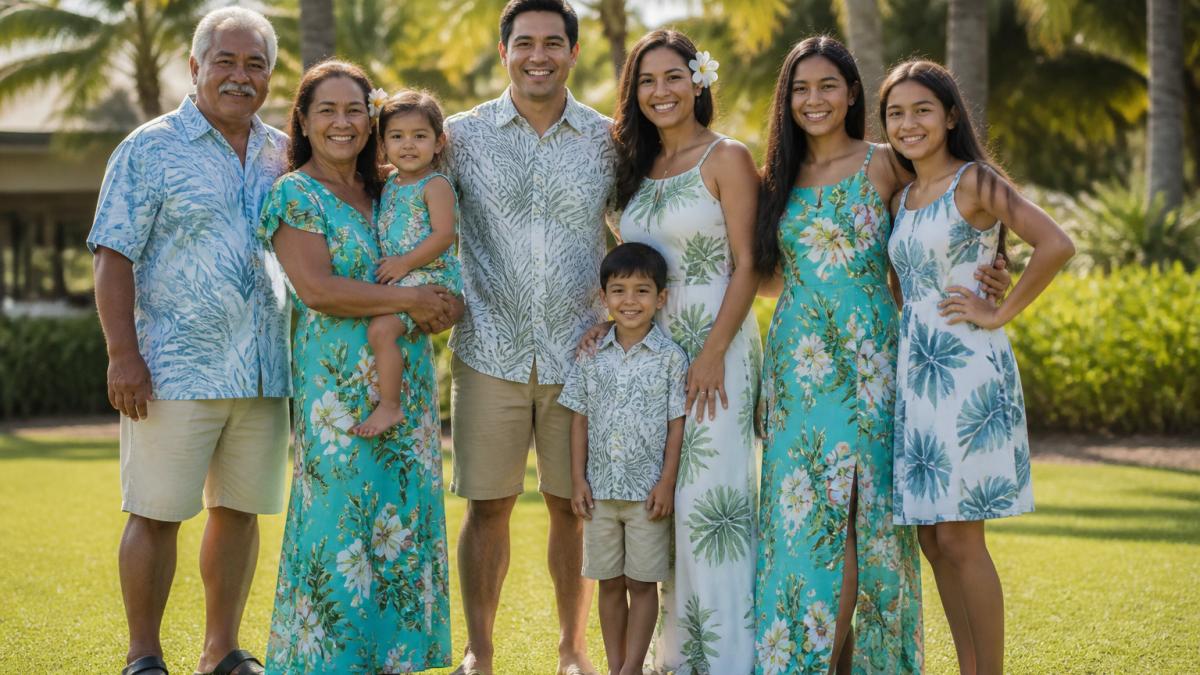
For larger family orders, plan ahead. Measure each person, note the fit preferences for each age, and confirm the design is available in every size you need. If your family spans several generations or heritages, choose designs that feel meaningful to everyone rather than only one side.
TonganToddler Sweatshirt | Kiliimasi Fiefia - Merry Christmas | Island Family →
Our [PAGE:1|Samoan family matching outfits guide] covers the full range of matching options for Samoan families. For multi-person orders, our [PAGE:3|custom group orders] page explains how we create matching shirts for reunions, birthdays, and events.
Matching Pieces to Occasions, from Everyday Wear to Celebrations
Mixed-heritage families rarely need one outfit for one kind of event. They need a small rotation that covers school days, family portraits, religious services, cultural festivals, and holiday gatherings, often with different branches of the family expecting different levels of tradition.
Everyday wear. Casual pieces are where most families start. Cotton-blend sweatshirts, tees, and tote bags carry a design without demanding formal protocol. They work for school runs, weekend errands, and casual visits with family.
Family portraits. Portrait sessions reward coordination without uniformity. A shared color palette or a single motif repeated across adults and children photographs well and reads as intentional. Avoid mixing too many bold patterns in one frame.
Religious and ceremonial events. Church services, weddings, funerals, and cultural ceremonies often call for more formality and more cultural specificity. This is the setting where a generic "Polynesian" print is most likely to cause friction. Ask family members from the relevant culture what is appropriate.
Cultural festivals and community events. Events like a local Pacific Islander festival, a church luau, or a community flag day are settings where traditional or semi-traditional attire may be welcomed. This is also where families often want to coordinate across generations.
Holiday gatherings. Holiday pieces, like a Tongan Christmas sweatshirt or a Samoan Christmas tote, can be worn beyond the holiday itself. The Tongan toddler sweatshirt at $29.99 is a soft cotton-blend piece that can go to a family Christmas party and then into the regular rotation. The Tongan Christmas toddler hoodie at $29.73 is made of cozy fleece.
A common mistake. Buying one bold holiday piece and expecting it to cover every event. A single festive sweatshirt will look out of place at a formal church service and overdone at a school pickup. Mix everyday and occasion pieces so each setting gets an appropriate option and the family actually wears what it buys.
Sizing and coordination across ages. Before ordering for a group, measure each person and check the size chart for every garment type, because a child's sweatshirt and an adult's tote do not share sizing logic. Check the size information on each product page before ordering.
Our [PAGE:1|Samoan family matching outfits guide] covers matching options for Samoan families, and our [PAGE:3|custom group orders] page explains how we create matching shirts for reunions, birthdays, and events.
Questions to Ask Before You Order Your Family's Pieces
Before ordering, ask these questions:
- Which culture or island inspired this design, and how does the maker explain it?
- Do the size charts match my family's measurements, including children?
- What is the fabric content, and how should it be cared for?
- How long does production and shipping take, and is the item in stock?
- Can the design be personalized or coordinated for a group order?
- Does the return or exchange policy cover fit problems?
Ask a family member from the culture behind the design if you can. Their feedback often reveals details a product page does not.
Frequently Asked Questions
What is traditional Polynesian clothing?
Traditional Polynesian clothing varies across the islands, from Samoan lavalava wraps and Tongan ta'ovala to Hawaiian kapa-based garments, and much of it was originally made from natural fibers such as tapa cloth. Many designs carried meaning tied to rank, family, and place. Today, most everyday pieces are contemporary garments that draw on these traditions through patterns, colors, and motifs. Knowing the origin of a design helps you appreciate what it is referencing and how to wear it respectfully.
How can a mixed heritage family choose Polynesian clothing that feels authentic?
Start by naming which heritages the family identifies with, then look for pieces that reference those specific cultures rather than a generic island look. Pacific-owned brands and designers often provide clearer cultural context about their patterns. Involve each family member in choosing, since their connection to each heritage may differ. Clothing can honor several backgrounds at once when the designs are chosen thoughtfully and explained honestly.
How can you tell whether a Polynesian-inspired design is culturally respectful?
Look for brands that explain where a pattern or motif comes from and which culture it belongs to. Be cautious with designs that mix motifs from many islands without explanation, or that treat sacred symbols as decoration. Check whether the maker is connected to the culture or works with community members. Respectful brands tend to be transparent about sourcing and design intent, and they welcome questions.
What should you look for when buying Polynesian family outfits?
Check sizing charts carefully, since many island-inspired brands run in different cuts, and look for measurements in inches with a clear fit guide for children and adults. Check the product page for shipping details before buying for an event. Matching outfits work best when the colors complement each other rather than matching exactly. Ask about fabric and care instructions so the pieces hold up across several wears.
Wake Up and Live is here to help your family find pieces that feel right, whether you are shopping for one person or planning a group order. Browse our island-inspired collection and choose the pieces that celebrate your heritage.
SHOP NEW ARRIVALS
