

Why Artisan-Made Clothing Costs More Than Fast Fashion
Last Updated: November 4, 2026
Quick Summary
Artisan-made clothing costs more because it is built one garment at a time by skilled hands, so you pay for the hours of work inside it, the maker's fair wage, and carefully chosen materials. Small-batch production also carries the full pattern grading, sample sewing, and machine setup costs that factories spread across thousands of pieces.
- A single handmade garment can take hours or days of focused work by one maker.
- A ten-piece run absorbs the same setup costs as a thousand-piece run.
- Fair wages are the largest single component of an artisan garment's price.
- Ask who made it, where, from what, and how before checkout.
- Divide price by wears: a weekly piece lasting three years beats a cheaper one that pills.
Table of Contents
- The Real Reasons Artisan-Made Clothing Costs More
- Artisan-Made vs Mass-Produced Clothing: A Side-by-Side Look
- Ethical Clothing Production Costs: Where Your Money Actually Goes
- How to Identify Artisan-Made Clothing Before You Buy
- Cultural Authenticity in Fashion and Why It Affects Price
- Does Artisan-Made Clothing Last Longer? The Cost-Per-Wear Math
- Shop Island-Inspired Pieces That Reflect Your Values
- Frequently Asked Questions
The Real Reasons Artisan-Made Clothing Costs More
Artisan-made clothing costs more because it is built one garment at a time by skilled hands, not assembled in thousands by machine operators working to a stopwatch. The Bureau of Labor Statistics analysis of secondhand apparel and clothing costs notes that clothing costs and environmental sustainability are now driving buyers toward alternatives, which tells you something: price alone stopped being the whole story.
Labor Hours Behind Every Garment
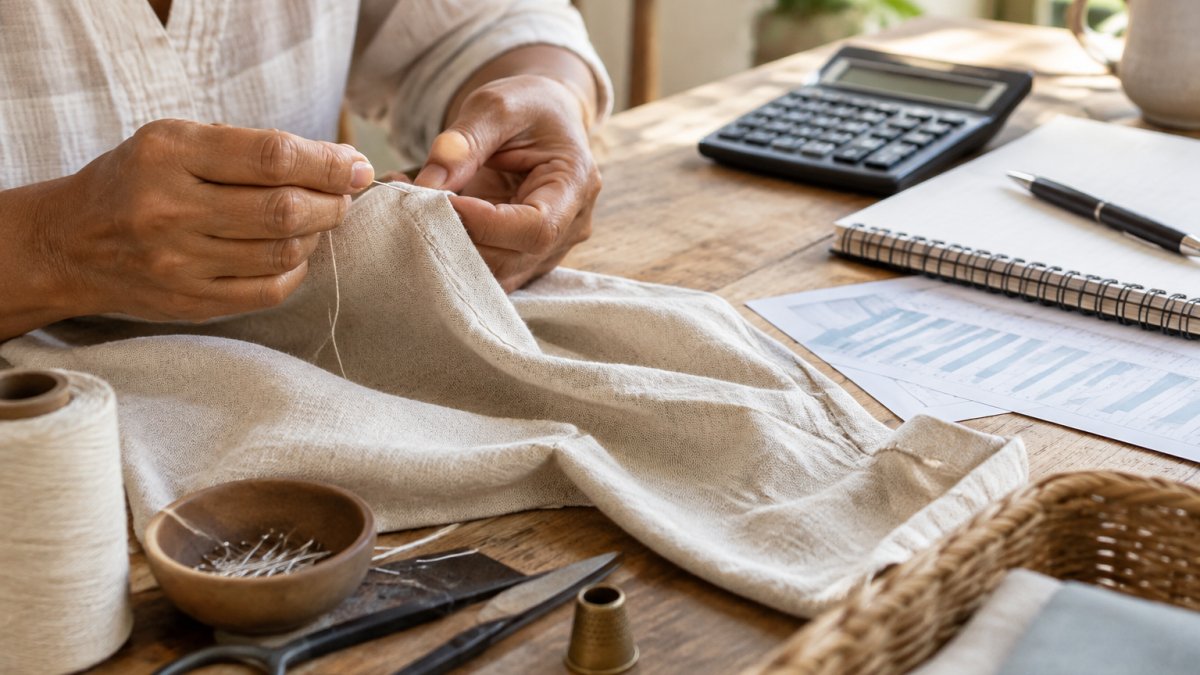
A single handmade garment can take hours or days of focused work, because one person cuts, stitches, dyes, and finishes it from start to finish. A 2026 guide to why handmade clothing costs more explains that the premium reflects time, skill, and fair labor rather than branding. That is the core of it. In a factory, a seam is one repeated motion across hundreds of pieces. In an artisan workshop, the same seam is fitted, checked, and adjusted to one body.
Small-Batch Production and Missing Economies of Scale
Factories buy fabric by the thousands of meters and spread setup costs across huge runs. Small-batch producers cannot. A ten-piece run carries the same pattern grading, sample sewing, and machine setup as a thousand-piece run, so each garment absorbs the full cost. That gap is what economists call economies of scale, and its absence is the single biggest line item separating handmade from mass production.
Artisan-Made vs Mass-Produced Clothing: A Side-by-Side Look
The difference between artisan-made vs mass-produced clothing comes down to how the work is organized, not just how the finished piece looks. Here is the comparison we walk customers through:
| Factor | Artisan-Made | Mass-Produced |
|---|---|---|
| Production run | Small batch, often made to order | Thousands per style |
| Labor | One maker, multiple skills | Divided across stations |
| Fabric | Chosen per garment | Bought at lowest bid |
| Wages | Fair wages, named maker | Low-cost labor, anonymous |
| Lifespan | Built to be repaired | Built to be replaced |
Fast fashion wins on retail price. It loses on garment lifespan, and that difference shows up later in your closet.
Ethical Clothing Production Costs: Where Your Money Actually Goes
Ethical clothing production costs are dominated by people and materials, not marketing. A fair wage is the largest single component of an artisan garment's price, and it is the one line fast fashion removes entirely. Research indexed by ScienceDirect on sustainable consumer behavior in fashion found that consumers are more likely to buy sustainably when they believe their choices make a difference, which is why transparency matters here.
A Garment-Level Cost Breakdown
Most cost breakdowns stay abstract. Here is the structure a small workshop typically works from, expressed as shares of the retail price rather than invented dollar figures, because the actual numbers move with fabric, region, and order size.
- Maker's labor: the largest line in most artisan garments. A handmade dress can take many hours of cutting, stitching, and finishing, and that time is paid at an hourly rate rather than a piece rate.
- Materials: artisan producers usually buy smaller quantities, so they pay higher per-yard prices than factories that commit to thousands of yards. Natural fibers, deadstock, and low-impact dyes add cost but also change how the garment wears and ages.
- Dyeing, printing, and finishing: hand processes add hours and skill that machine finishing does not require. This is also where much of the visible character of a piece is created.
- Overhead: studio rent, equipment, sample making, pattern grading, and the cost of unsold inventory in a small run. A ten-piece run spreads these costs across ten garments instead of thousands.
- Shipping and platform fees: packaging, freight, and payment or marketplace fees are fixed costs that hit small producers harder per unit.
- Margin: what is left after all of the above. For many small workshops this is modest, which is why artisan pricing is not a branding premium in the way mass-market pricing can be.
A Kahindo comparison of artisan and factory dress pricing gives price ranges for both, though it does not publish durability testing, so treat any single comparison as a starting point rather than proof. The useful takeaway is the shape of the breakdown, not any one number: labor and materials dominate, and the absence of scale shows up in every line.
Watch out: a brand that makes transparency claims but will not name the workshop or the wage basis is offering marketing rather than proof.
How to Identify Artisan-Made Clothing Before You Buy
You can identify artisan-made clothing by asking four questions before checkout: who made it, where, from what, and how. A maker who can answer all four is usually telling the truth. Vague "island-inspired" language with no named producer is a warning sign.
- Is the maker or workshop named?
- Is the fiber content listed in detail?
- Are care and repair instructions included?
- Does the size chart give measurements, not just S/M/L?
Those four questions are the floor, not the ceiling. The harder part is verifying the answers, because most marketing language is designed to sound transparent without being checkable. Here is how to go further.
Verify the wage claim
A fair-wage claim should tell you the basis: hourly rate, piece rate, or a published wage floor. Ask whether the brand can state the wage relative to the local minimum or a recognized living-wage benchmark. If the answer is only "we pay fair wages," treat it as unverified. A common pattern among credible small producers is to publish the hourly rate and the number of hours per garment, which lets you sanity-check the labor share of the price yourself.
Verify the production location
"Designed in" is not "made in." Look for a named city or region of production and, ideally, the workshop itself. A brand that lists a country but cannot name a region or facility is giving you a category, not a location. Cross-check the address or facility name against the brand's own about page and any third-party coverage.
Verify artisan attribution
A named maker is a stronger signal than a named brand. Look for a person, a workshop, or a cooperative with a traceable identity, and check whether the same name appears across multiple product pages and outside the brand's site. Attribution that changes from page to page, or that reduces to a generic "our artisans," is weaker evidence.
Verify certifications and standards
Certifications are useful only when you know what they cover. A certification for organic fiber does not verify wages; a fair-trade certification does not verify fiber content. Check the certifying body's public standard and confirm the brand's claim matches the scope of the certification. Where no certification exists, a brand that explains its own audit process and names the auditor is more credible than one that simply displays a logo.
Read the return and repair policy as evidence
A maker confident in construction will usually offer repairs or a clear repair path. A generous return window plus repair support is a practical signal that the garment is expected to last. A policy that discourages returns or offers no repair route is a signal in the other direction.
If you are choosing pieces for a family with mixed heritage, our guide on how to choose Polynesian clothing for mixed heritage families walks through fit and cultural considerations in more depth.
Watch out: a certification logo with no certifying body named, or a wage claim with no basis stated, is the most common way unverified marketing passes as transparency.
Cultural Authenticity in Fashion and Why It Affects Price
Cultural authenticity in fashion affects price because authentic design carries knowledge that cannot be copied cheaply. Patterns, motifs, and construction methods passed down through families take years to learn. When a brand pays for that knowledge, the price reflects it. When a retailer borrows a motif and prints it offshore, the price reflects neither the culture nor the maker. If you are weighing brands against each other, our article on how to compare Polynesian brands fairly lays out a fair framework.
Does Artisan-Made Clothing Last Longer? The Cost-Per-Wear Math
Artisan-made clothing often lasts longer, and cost per wear is how you prove it. Divide the price by the number of times you wear the garment. A piece worn weekly for three years beats a cheaper piece that pills after ten washes, even at twice the sticker price. A McKinsey State of Fashion 2026 report notes that tariffs and trade shifts are pushing costs up across the fashion supply chain, which makes durability a financial argument, not just an ethical one. The honest caveat: not every expensive garment is well made. Above a certain price, extra dollars buy branding, not better construction.
Shop Island-Inspired Pieces That Reflect Your Values
Now that you know where the money goes, the next step is finding pieces that match those values. Our clothing collection features island-inspired styles for women, men, and children, made for everyday wear and intentional living. If you want to know who is behind the brand, read about Wake Up and Live and what we stand for. And if you are shopping for someone else, our guide to island-inspired gifts for tropical style lovers is a good place to start.
Frequently Asked Questions
Why is handmade clothing more expensive than factory-made clothing?
Handmade clothing generally costs more because one skilled person cuts, stitches, and finishes each piece instead of a machine line turning out large volumes. Labor takes real time, and smaller fabric orders and limited production runs tend to raise the price. Artisan-made clothing often uses natural fibers and traditional techniques that take longer than automated processes. The premium reflects real time, skill, and materials, not a markup for the label.
How can you tell whether artisan-made clothing is worth the price?
Check three things: who made it, how it was made, and how long it lasts. Look for named makers or cooperatives, details about techniques like hand-dyeing or hand-finishing, and care instructions that signal quality construction such as reinforced seams and natural fibers. Then do the cost-per-wear math. Divide a garment's price by the number of times you wear it to compare its cost per wear. Ask the brand directly about production and wages if the information is not on the site.
Does buying artisan-made clothing actually support the people who make it?
It can, but only when the brand is transparent about its supply chain. Ethical clothing production costs include fair wages, safe working conditions, and often community investment. Look for brands that name their artisan partners, explain how they set wages, and publish details about their production process. When those details are missing, ask. Consumers are generally more likely to buy when they believe their choices make a difference, which makes verifying the claim before you buy the responsible move.
What should shoppers look for when evaluating cultural authenticity in fashion?
Start with attribution. Authentic cultural authenticity in fashion means the brand credits the specific culture, community, or artisan group behind a design, not just a vague island-inspired label. Look for named designers or makers with ties to the culture, explanations of traditional techniques used, and fair compensation for the communities involved. Ask whether the patterns and motifs have cultural meaning and who benefits from their use. Brands that celebrate a culture and pay the people within it are different from brands that borrow the aesthetic without the connection.
The gap between a cheap garment and a handmade one is not mystery markup. It is hours, wages, materials, and care. We built Wake Up and Live around island-inspired styles, feel-good fashion, and self-care finds for the whole family, so you can celebrate your culture and individuality without settling for disposable clothing. Get started with Wake Up and Live and shop new arrivals that help you look and feel your best every day.
